

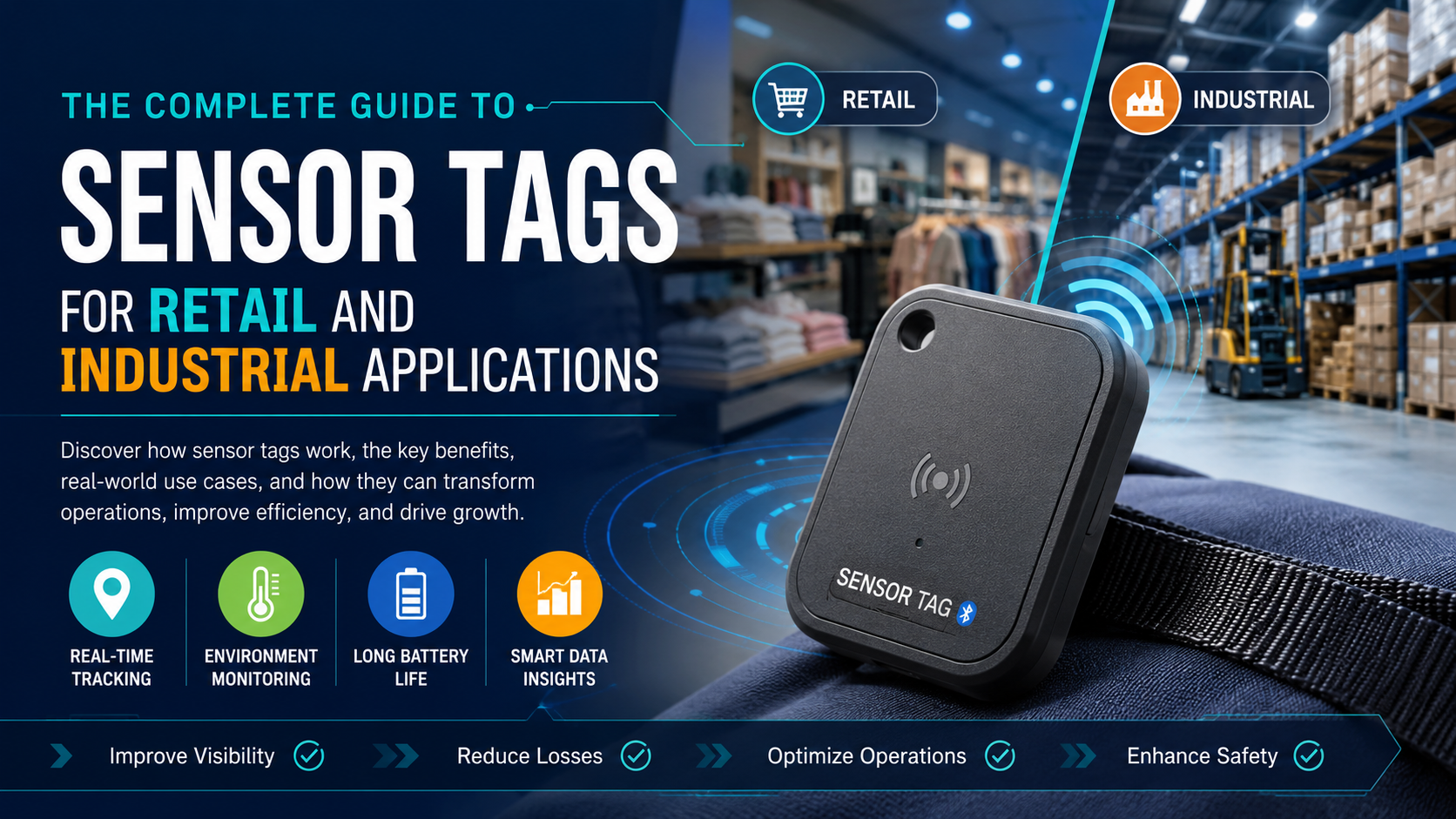
The Complete Guide to Sensor Tags for Retail and Industrial Applications
Modern businesses need better ways to track products, equipment, inventory, and operating conditions. Traditional labels can identify an item, but they often cannot provide the real-time information businesses need to make faster decisions. This is where sensor tags can become valuable, combining identification with sensing capabilities for applications that require more than simple tracking.
Retailers and industrial operators use sensor-based tagging to monitor inventory, detect environmental changes, improve asset visibility, and reduce operational losses. However, choosing the right technology requires an understanding of how sensor tags work, what they measure, and where they deliver the most value.
What Are Sensor Tags?
Sensor tags are identification devices that incorporate one or more sensors to collect information about an item or its surrounding environment. Depending on the design, a tag may monitor temperature, humidity, pressure, motion, light, vibration, location, or other conditions.
Unlike conventional identification labels, sensor tags can provide data that helps businesses understand what is happening to an asset rather than simply identifying it.
A typical system may contain three components:
- Sensor: Measures a physical condition such as temperature or movement.
- Tag electronics: Processes or stores the collected information.
- Reader or communication system: Transfers information to a monitoring platform.
Some tags communicate through RFID, Bluetooth Low Energy, near-field communication, cellular networks, or other wireless technologies. The appropriate option depends on the required range, battery life, data frequency, and operating environment.
How Sensor Tags Work in Real-World Applications
The basic workflow is relatively straightforward. A sensor detects a change, the tag records or transmits the measurement, and software interprets the information.
For example, consider a warehouse storing temperature-sensitive products. A temperature-sensing tag can monitor conditions throughout storage and transportation. If temperatures move outside an acceptable range, the system can generate an alert.
In another scenario, a manufacturer could attach vibration sensors to critical machinery. Unusual vibration patterns may indicate developing mechanical problems. Maintenance teams can investigate the equipment before a minor issue becomes an expensive failure.
The value comes from connecting physical conditions with actionable business information.
Retail Applications of Sensor Tags
Retail environments have several opportunities to use sensor-based monitoring.
Inventory Monitoring
Retailers lose time and money when inventory records do not match physical stock. Sensor-enabled identification can improve visibility by helping staff locate, count, and monitor products.
For example, a retailer could use RFID-enabled tags to identify merchandise throughout a store and backroom. Staff can spend less time searching for products and more time assisting customers.
Cold-Chain Monitoring
Grocery stores, pharmacies, and other businesses handling temperature-sensitive products need reliable environmental monitoring.
Temperature sensors can help identify whether products have experienced unsuitable conditions during transportation or storage. Instead of relying entirely on manual temperature checks, businesses can create a more consistent monitoring process.
Theft and Loss Prevention
Sensor tags can also support loss-prevention strategies. Movement, proximity, or location information may help identify unusual activity around valuable merchandise.
The technology should complement existing security procedures rather than replace them. Businesses should also consider customer privacy and clearly define how collected data is used.
Store Operations
Retailers can use sensors to understand operational conditions such as equipment usage, refrigerator temperatures, or movement patterns. These insights can support better maintenance and resource allocation.
Industrial Applications of Sensor Tags
Industrial environments often require more rugged and specialized solutions.
Equipment Condition Monitoring
Unexpected equipment failures can cause production delays and expensive repairs. Sensor tags can monitor vibration, temperature, pressure, or other indicators associated with equipment health.
Suppose a motor normally operates within a predictable vibration range. A gradual increase may signal imbalance, bearing wear, or another developing problem. Maintenance personnel can then inspect the equipment before failure occurs.
Asset Tracking
Factories often have thousands of tools, containers, components, and mobile assets moving between locations. Tags can make these assets easier to identify and track.
This is especially useful when equipment is shared between departments or frequently transported across large facilities.
Environmental Monitoring
Industrial processes may depend on controlled environmental conditions. Sensors can monitor temperature, humidity, pressure, or other variables in storage areas and production environments.
Continuous monitoring can provide a clearer operational picture than occasional manual inspections.
A Step-by-Step Strategy for Implementing Sensor Tags
Successful deployment starts with the business problem rather than the technology.
1. Define What You Need to Monitor
Determine whether you need to track location, temperature, movement, vibration, inventory, or another condition. Avoid collecting data simply because a sensor can collect it.
2. Identify the Operating Environment
Consider exposure to heat, moisture, dust, chemicals, vibration, and physical impact. An indoor retail tag may require completely different protection from a tag used on industrial machinery.
3. Select the Communication Technology
RFID can work well for identification and inventory processes, while Bluetooth may suit applications requiring wireless communication over moderate distances. Cellular connectivity can be useful for remote assets.
Range, infrastructure, power consumption, and installation costs should all influence the decision.
4. Determine Power Requirements
Battery-powered tags offer flexibility but require maintenance planning. Battery life depends on sensor frequency, transmission intervals, environmental conditions, and communication technology.
For long-term deployments, calculate expected battery replacement requirements before implementation.
5. Establish Data Rules
Decide how frequently measurements should be collected and what conditions should trigger alerts.
For example, a cold-storage application may need frequent temperature readings, while an asset-location application may only need periodic updates.
6. Test Before Scaling
Start with a limited pilot. Test tag performance, connectivity, battery life, data accuracy, and user workflows.
A small deployment can reveal problems that may otherwise become expensive after thousands of tags are installed.
Common Mistakes and Challenges
One common mistake is selecting tags based solely on price. A low-cost tag may become expensive if it has poor battery life, unreliable communication, or insufficient environmental protection.
Another challenge is poor sensor placement. A temperature sensor attached to an unsuitable location may not accurately represent the condition that matters.
Data overload is another concern. Collecting measurements every few seconds may generate unnecessary information and increase storage and processing requirements. Businesses should determine the minimum data frequency needed to support decisions.
Integration can also become complicated. Sensor systems should ideally connect with existing inventory, maintenance, warehouse, or enterprise software instead of creating another isolated data source.
Practical Tips From an Implementation Perspective
Start with one measurable business outcome. Reducing inventory search time, preventing temperature excursions, or identifying equipment problems gives the project a clear objective.
Create alert thresholds carefully. Too many false alarms can cause employees to ignore notifications. Alerts should indicate situations that genuinely require attention.
Keep installation consistent. Standardized tag placement improves data reliability and makes replacement easier.
Review the system regularly. Sensor deployments should evolve as business processes change. Periodic reviews can reveal unused sensors, unnecessary data collection, connectivity problems, or opportunities for expansion.
Most importantly, treat sensor data as operational information rather than an end product. The real benefit appears when employees can use that information to make faster and better decisions.
Conclusion
Sensor tags can bridge the gap between physical assets and digital business systems. In retail, they can improve inventory visibility, environmental monitoring, and loss prevention. In industrial settings, they can support asset tracking, condition monitoring, and predictive maintenance.
The best results come from starting with a specific operational problem, selecting suitable sensing and communication technologies, testing the solution in a controlled environment, and connecting the resulting data to practical workflows. When implemented thoughtfully, sensor tags become more than identification tools—they become a useful source of real-time operational intelligence.
